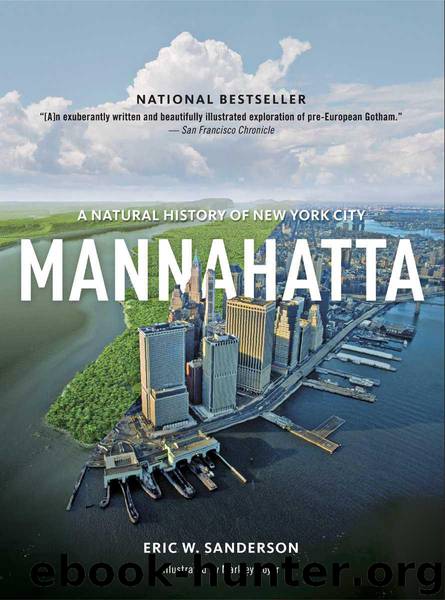
Mannahatta: A Natural History of New York City by Sanderson Eric W
Author:Sanderson, Eric W. [Sanderson, Eric W.]
Language: eng
Format: epub
Publisher: Harry N. Abrams
Published: 2013-11-26T22:00:00+00:00
Skyscrapers, like everything else in our landscapes, are not permanent. Over the next four hundred years, nearly all the buildings on Manhattan will be torn down and rebuilt, not through whole-scale change, but block by block, building by building. In this patchwork of opportunities lies the possibility of creating a more sustainable city. here Workers tear down the Hanover National Bank building in 1931. See next image.
A new skyscraper rises in Midtown. See previous image.
In breathing, buildings also need to take care not to poison the air. Although that may seem so obvious as to not need saying, an unintended property of some twentieth-century building materials is that they “off-gas” substances that we shouldn’t breathe in. The materials can’t help it, but we can help what materials we use. We can, for example, choose materials devoid of toxic substances. And we can consider the life-span of the nontoxic materials, using building blocks that participate in cycles of use and reuse, what William McDonough has called “cradle-to-cradle” cycles, rather than “cradle-to-grave” linear processes, in which something is used only once and then thrown away. Like the nutrients that cycled through Mannahatta’s ecosystems, the stone, wood, metal, and even plastics of our buildings should be designed for use and reuse.
Each building is not an island unto itself; it is a part of the main—that is, buildings, like the individual forests, streams, and grasslands of the landscape, create contexts for other things to happen. Jane Jacobs famously lectured New York in the 1960s on the value of mixed-use neighborhoods, where people can work, shop, and live in close proximity. She should have asked deer to show the way—white-tailed deer know that the best way to live is close to the grasses you love, near the shrubs that shelter, and beside the stream to drink. The same goes for people—we live best, our communities thrive most, when everything we need, including family, friends, home, and work, is near at hand.
Download
This site does not store any files on its server. We only index and link to content provided by other sites. Please contact the content providers to delete copyright contents if any and email us, we'll remove relevant links or contents immediately.
The Lonely City by Olivia Laing(4847)
Animal Frequency by Melissa Alvarez(4513)
All Creatures Great and Small by James Herriot(4362)
Walking by Henry David Thoreau(4004)
Exit West by Mohsin Hamid(3860)
Origin Story: A Big History of Everything by David Christian(3726)
COSMOS by Carl Sagan(3671)
How to Read Water: Clues and Patterns from Puddles to the Sea (Natural Navigation) by Tristan Gooley(3512)
Hedgerow by John Wright(3408)
How to Read Nature by Tristan Gooley(3390)
The Inner Life of Animals by Peter Wohlleben(3349)
How to Do Nothing by Jenny Odell(3340)
Project Animal Farm: An Accidental Journey into the Secret World of Farming and the Truth About Our Food by Sonia Faruqi(3257)
Origin Story by David Christian(3231)
Water by Ian Miller(3220)
A Forest Journey by John Perlin(3098)
The Plant Messiah by Carlos Magdalena(2967)
A Wilder Time by William E. Glassley(2899)
Forests: A Very Short Introduction by Jaboury Ghazoul(2869)
